


The coal industry has been touting coal liquification as a viable gasoline replacement for years. The industry wants us to believe that since the US already has an abundance of cheap coal, coal liquification is the fastest and most cost effective way for us to achieve energy independence. This doesn't appear to be the case when you consider the cleaner alternatives and the true costs of liquid coal - the environmental costs. Carnegie Mellon's Electricity Industry Center recently came out with a report that concluded that passenger vehicles using coal to liquids gasoline had the worst greenhouse gas emissions, and that plug-in hybrid electric vehicles had the lowest GHG emissions.
As the chart below shows, the difference in the emissions isn't even close - plug-in hybrids, when charged by coal plans using carbon capture sequestering technology, had about 1/3 the the GHG emissions as a conventional gasoline vehicle, and roughly 20% of the emissions from a vehicle fueled by liquid coal gasoline.  So why do we continue to see more subsidies targeted to liquid coal companies and alternatives such as corn based E85 when there is so much evidence out there that these solutions are not safe and smart alternatives to foreign oil? Well, the subsides give our politicians an opportunity to suck up to two very powerful industry lobbies - coal and corn. If your congressman supports these two alternative fuels - he or she is not looking out for the best interests of their constituents. They are looking out for the corporate interests. Please write, email, or call your congressman and ask them if they support liquid coal or corn ethanol based fuels. If they do, please remind them that supporting these fuels will put us on a faster path to social and environmental destruction.
More on this at the Terrapass blog.
Wednesday, August 22, 2007
Coal-to-liquids - a dangerous substitute for foreign oil

Wednesday, June 27, 2007
Got Milk? Spike in fuel and corn prices driving the price of milk to all time highs
The mainstream media has finally broken the news - higher demand for ethanol has lead to a chain reaction of inflation throughout the food chain. Dairy products like milk, cheese, and pizza are experiencing inflation due to dairy farmers having to raise their prices with a gallon of milk approaching $4 at the grocery stores.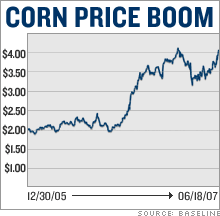
Now here is my question to you. For the short term consumers are going to suffer from both $3 gasoline and $4 milk, but what does this mean for the long run?
I for one think it could save us from going farther down a path towards chaos. I am serious when I say that. Corn is a commodity that should not be treated like a non-renewable fossil fuel. With the exception of natural events such as hurricanes, droughts, etc the price of corn should remain stable and not be subject to shortages due to government policies.
If our governments, both federal and state, continue to subsidize ethanol investments then we are going to be in a heap of trouble. There is only so much land available to grow corn and only so many bushels of corn that can supply ethanol fuel without affecting our food chain.
So, is there anyone out there who still think that corn based ethanol won't have a big impact on our food chain?
Tuesday, June 19, 2007
What happens when politicians are former scientists, engineers, and economists?
They actually get it! China is considering a ban on all corn and food based fuel production. The politicians in China realize the consequences of food inflation due to increased demand in the corn when used for fuel. Amazing isn't it?
Message to our government - swapping Petro based fuels for Ethanol is not the answer!!!
While we're on the subject of ethanol, for those of you with access to The Wall Street Journal, Matt Vella has an excellent story on his road trip around the US driving an E85 FlexFuel Chevy Suburban. Mr. Vella points out that while there are environmental benefits to driving with E85 fuel, because of lower fuel efficiency of ethanol a gasoline only Toyota Prius would achieve great efficiency and less green house emissions. Here are some of the highlights:
"My excitement at having a full tank of E85 was quickly dulled by the lack of perceptible performance difference between the renewable fuel and regular gas. The driving experience was, in fact, indistinguishable. No electrical whine of a hybrid motor. No gurgling growl of a diesel. Nothing to let me know I was driving greener.
Reduced fuel economy was noticeable. A Suburban gets between 14 and 20 miles per gallon, whereas on E85 the same vehicle earns just 10 to 15 miles per gallon.
Pros: E85 is a renewable energy source; growing feedstock – usually corn -- recycles carbon; fewer emissions; gas engines require no modifications to run E10, a blend of gas with 10% ethanol, and minor changes to burn E85; cost premium of an E85 capable vehicle is just a small fraction of diesel or hybrid technology; flex-fuel vehicles can run on either gas or ethanol.• Cons: E85's low-energy content drops flex-fuel vehicles' fuel economy by about 30%; limited availability; looming concerns over water used to grow crops, soaring corn prices.
"
Friday, March 2, 2007
Governor Rendell's speech at Pittsburgh Tech Council Luncheon
 "I truly believe, that over the decade from 2010 to 2020, the production of alternative energies will have an impact the equivalent of what information technology has had on our economy."
-Governor Ed Rendell at Pittsburgh Technology Council luncheon on Friday March 2nd, 2007
After attending Governor Rendell's speech today at the
 Sheraton at Station Square, I came away believing that the Governor is both very knowledgeable and passionate about making the Commonwealth of Pennsylvania a leading alternative energy state. Governor Rendell covered a lot of ground in the 1 hour he spoke to us, and gave us an overview of the plan while answering some tough questions from the crowd. This was my first time at an event with a government official of Rendell's stature and I was pumped after getting the opportunity to ask Governor Rendell a question regarding his solar rebates one on one.
Some other highlights for me personally - I was able to meet several "green" entrepreneurs, including an individual working on coal gasification technology, several state and local politicians, and also representatives of Western PA businesses who have a stake in the Governor's energy initiatives.
Here are some highlights from Rendell's speech:
1. The Governor is a big believer in cellulosic ethanol. One test plant is currently under development in Clearfield County while several others are in the planning stages.
2. The State has billions of tons of Waste coal which will be put to use in coal gasification and biodiesel plants across the state. There are not any of plants in the US currently utilizing the Ficher-Tropsch process, which is a process that breaks down coal or biomass into liquefied form to be used as synthetic fuels.
3. The Governor is working to get more gas stations to include E85 at the pump. The Sheetz gas station chain has been introducing several E85 pumps at their stores throughout Western PA. Governor Rendell also mentioned that E10 should be mandatory at all gas pumps throughout the state, as it is in parts of the Philadelphia area.
Well, there is a lot more but I want to close with a remark on the Energy initiatives solar incentives. The Governor's plan includes $200 million in solar installation rebates to homeowners and businesses. The plan will give a rebate of up to 50% of the cost of the installation. My question to the Governor was this:
"Assuming a typical house in PA requires a 2.5kw solar system, the cost would be $30,000. After the 50% rebate and $2,000 federal tax credit, the cost drops to $12,000 to $13,000. How is the average homeowner in PA going to afford that payment, even after the rebates and federal credit? Have you worked out an agreements with financial institutions to offer low interest rate financing for the $12k to $13k out of pocket expense for a solar system?"Governor Rendell's reponse, after realizing I was talking about the financing of the purchase and not the program's rebates:
"I haven't thought of that but that is a great question, it's something I will have to think about."So, I think the plan looks great on paper but how many of us can really afford to plunk down over $10k for a solar system? Without special financing programs this would be close to another car payment for some of us. I think the Governor was sincere when he said he would think about it and I hope to see an announcement of a solar financing plan for homeowners down the road. Please post any comments if there is anything specific you would like to know about the plan or Governor Rendell's speech today, there is a ton more to talk about. I could go on for several more paragraphs (I have some amusing video clips from the event too!)
Thursday, March 1, 2007
5 questions for Vinod Khosla
Sun Microsystems cofounder, Carnegie Mellon Alum, and cellulosic ethanol evangelist Vinod Khosla of Khosla Ventures recently spoke to Fortune Magazine about the future of ethanol and alternative fuels.
You got on the ethanol bandwagon early. What's on tap for 2007?A great analysis of Kholsa's stance on alternative energy and ethanol can be found at The Oil Drum blog.
This will be the year of cellulosic ethanol - fuel made from grasses, wood chips, and other underutilized biomass. New fuels like butanol will also come along. I wouldn't be surprised to see biogasoline either. We'll see biofuels move from their role as an additive to gasoline to a primary fuel for automobiles.
What still stands in ethanol's way?
You'll see critics, often funded by the petroleum interests, increase their attacks on biofuels through surreptitious PR campaigns, while publicly supporting these renewable fuels. We might even see oil prices manipulated down to thwart this transition, which is essential for our planet.
What 10 top leaders and thinkers see on their horizon
What other areas of alternative energy should we be watching?
Coal. We will continue to see a push for "clean coal," as it's a way for a few of the traditional power-generation firms to delay action. Clean coal will be in a horse race with wind and solar. I'd personally handicap solar thermal, not photovoltaic solar or clean coal to win.
How will Congress and the presidential candidates affect the equation?
The biggest leverage will come from the similar positions of the presidential candidates for 2008. Most of the rumored candidates already support an aggressive biofuels policy, as do the Democratic majorities in Congress and the Bush administration.
Where are you investing, outside of green tech?
We're excited about mobile applications and see breakthroughs in semiconductors and batteries.
Thursday, February 22, 2007
"If you really want to reduce the amount of oil that you consume, you have to reduce the amount of gasoline you use,"
Its that easy folks! You gotta love how President Bush breaks down one of our nations most complex problems. Use less gasoline, consume less oil. Next issue!
Okay, oil problem solved. Now what happens when we replace our entire, or most of our oil based vehicle fleet with ethanol based fuel? Are we better off? Not really. The ripple effect of using the farmers corn crop for fuel rather than food is going to be felt beyond our borders. Not only will farmers need to find a cheaper source of food for their livestock, but a sharp rise in demand for corn will hurt worldwide food production. Mexicans are already feeling a sting as the price of corn tortillas, a staple in the diet of most Mexicans, has risen steeply (corn has more than doubled over past year) ever since we started using ethanol as a gasoline additive.
Unfortunately, since the politicians must go through Iowa in the primaries, none of the Presidential candidates have acknowledged the downside of ethanol. Who gets it in Washington? I'm not sure if any of them "get it." John McCain was one of the few politicians who called out the bogus claims made by the pro-ethanol crowd, but now that he is running for President forget about it. More politicians need to jump on the Solar bandwagon. If we can get more homes using solar power, and get some electric or plug-in hybrid vehicles on the road, you have the cleanest source of electricity powering a potentially zero emission vehicle. You can't come close to that with corn!
Tuesday, January 30, 2007
The Sum of All Ears...........of Corn
Economist and NYT columnist Paul Krugman criticized the Bush energy policy in a recent NYT column that is posted here at the Economists view blog.
Besides stating the obvious blunders of the Bush administration's ethanol focus, Krugman mentions a key fact -
".....subsidizing ethanol benefits two well-organized groups: corn growers and ethanol producers. As a result, it’s bad policy with bipartisan support."
The bipartisan support thing is a huge problem........those of us following green tech in the blogosphere realize that ethanol is not the road to energy independence. The problem, is that while those of us following these issues "get it", there is usually a considerable lag before the politicians jump on the bandwagon (lots of polling!). Politicians and Presidential candidates on both sides of the aisle are on the ethanol bandwagon - THIS IS NOT GOOD!
The Democrat party (sorry, couldn't resist - must be the Texas thing) has a huge choice to make, one that will separate themselves from the pork lovin 'Pubs. If they truly care about increasing fuel efficiency then they will make the right decision in putting the best interests of the nation ahead of those of the corn belt states by focusing on technologies such as electric cars rather than settling on E85.
It is not in the nature of the Democratic party to reduce or eliminate tariffs, which would be a pro-trade move, as it would hurt the corn growers while making both home grown and imported sugar ethanol more competitive with gasoline. Since this would be a very unpopular move, especially with the 2008 elections on the horizon, it is not likely to happen. Therefore the politicians, the ones who "get it" (John McCain did until he decided to run for President) need to get behind alternative solutions. Maybe Bush's switchgrass idea isn't so "corny" after all.
Sunday, January 28, 2007
State of Denial
The Bush Energy Plan too focused on corn ethanol.
The latest White House Energy plan, which looks the same as the 2006 plan, focuses on inefficient corn based ethanol as well as "clean" coal burning plants. While he does mention cellulosic ethanol, the reaction of Senator Tom Harkin and other congressmen from the corn belt make it evident that corn based ethanol will be the focal point in getting to that 20% reduction in gasoline consumption. While the corn states stand to benefit handsomely from this energy policy, the shift from foreign oil to ethanol makes little sense if you look at the facts. Not only does corn ethanol have lower fuel efficiency compared to gasoline, but the amount of processing involved, the fertilizer, and the all those lovely subsidies make it more costly than importing oil, at least at current prices. On top of that, corn based ethanol is only slightly better in terms of greenhouse emissions.
An even bigger consequence of shifting the source of our fuel supply from oil to corn is the effects on our domestic food supply. The Wall Street Journal, among others, had a great article (subscription req'd) on the impact this energy policy will have on our economy.
To start, the article mentions that 20% of our corn crop is now devoted to ethanol production, whereas 5 years ago it was only 3%. This has led to a steep increase in the price of corn, up 80% in 2006, and has made a huge ripple effect across the food chain in North America, from the higher prices cattle farmers have to pay to feed their stock, to the 30% increase in the price of corn tortillas, a staple in the diet of most Mexicans.
So, while Senator Harkins, his fellow Iowans, and others in the corn belt are very pleased with this energy policy, I am sure once the facts are known the majority of Americans concerned with this issue will be left scratching their heads. Move over big oil, its time for big corn.

