


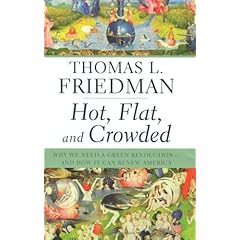
I just watched Tom Friedman discussing his new book "Hot, Flat, and Crowded: Why We Need a Green Revolution--and How It Can Renew America" on today's Meet the Press. One of the things he mentioned when discussing the book was his chapter titled "China for a day." In this chapter Friedman says he talks about how the US could push through solutions for our energy crisis if the government could just decide to go forward and do it, rather than Congress having to deal with the lobbyists and the red tape within the Washington bureaucracy. If there is one positive about China's communist government it is that when China decides to commit itself to doing things to advance good causes, they get it done.
Here in a democratic republic like the US, we can't afford to wait for the government to do its dance with the lobbyists and special interest groups and then hope that they make the right decisions on big issues like energy policy. That is why Friedman told Tom Brokaw that instead of a government sponsored Manhattan project for energy, he would rather see the "next economic revolution", what he called the ET or energy tech revolution, follow the model created by the Information Technology revolution - supporting and encouraging the start up of 100,000 companies that will attempt to solve one piece of the renewable energy problem.
I have pre-ordered the book, which is officially on the shelves tomorrow (Monday). The book sounds like it will be a hit like Friedman's other efforts. It also sounds like something the eventual President-elect needs to read between election day and their inauguration in January.
Sunday, September 7, 2008
China for a day

Thursday, November 15, 2007
Book review: Supercapitalism by Robert Reich

I just finished reading Robert Reich's new book, Supercapitalism , and I highly recommend the book to anyone who wants to learn how our roles as consumers and investors have created a Democracy that is run by corporate interests and the lawyers and lobbyists that work on their behalf to shape our domestic and foreign policy.
Basically, Mr. Reich, a professor of public policy at Cal Berkley who was President Clinton's Secretary of Labor, says that we "are of two minds." On the one hand, as consumers and investors, we want the best deals. We want to purchase cheap goods we want the companies that we invest in to give us the highest returns by generating higher margins and profits quarter after quarter, year after year. This creates a conflict with the citizen in many of us. Our "wants" as consumers and investors lead to social consequences that do not support, such as jobs moving overseas, small businesses being closed down by the likes of Wal Mart, and millions of Americans who work 40+ hours a week going without health insurance.
The problem, is that our politics in Washington is run by Supercapitalism, which does not give you or me, as citizens, much of say in public policy, because we are drowned out by the money and power of corporate interests. Supercapitalism has rewarded the consumer and investor in us by creating a frenzied competition among companies to win and retain customers. This leads to better and cheaper products for consumers and higher returns for investors. Because of this intensified competition for customers and higher returns, corporations are also in competition for the influence over members of Congress, and they achieve this through their PACs and corporate lobbying offices in Washington, which spend millions of dollars on campaign donations, lunches, and consultants.
Mr. Reich goes on to provide some solutions to Supercapitalism, and believes that the key to returning power back to the people is aggressive and comprehensive campaign finance reform in addition to enforcing rules that permit only people the ability to participate in the democratic decision making process. The power must be taken away from the corporations - since corporations are not citizens.
Finally, it wouldn't be right if I didn't comment on how Supercapitalism has impacted our environment. If you have read any of op-ed pieces from scientists who claimed that Global Warming is a scam or a farce I have news for you: those "experts" were most likely paid consultants to the big energy companies.
From the book, and Exxon's own internal documents:
- "In 1998, Exxon embarked on a campaign to give 'logistical and moral support' to any dissenter from scientific findings documenting global climate change, 'thereby raising questions about and undercutting the prevailing scientific wisdom,'"
- In 2002 Stanford University signed a ten year deal with Exxon and other energy companies in return for $225 million for a "Global Climate and Energy Project." Following the agreement Exxon ran ads on the op-ed page of the New York Times announcing that the "best minds" at Stanford agreed with Exxon's position on climate change. One add even featured the signature of a well known Stanford professor.
- In 2005 ExxonMobil distributed $2.9 million to thirty-nine groups that would raise doubts about climate change.
 Wow, I am shocked that Stanford "sold out" for $225 million. Haven't they made enough money off of Google and the numours alumni who have become millionaires and billionaires many times over? Shame on you Stanford. Maybe this means that the "S" in your logo should stand for "Satan"?
Then again, maybe this example is typical of how universities will operate under Supercapitalism? It is frightening to think how easily the integrity of some of our highest of higher education institutions may be "sold down the river" to the energy industry.
To read Mr. Reich's take on this subject, check out his blog entry at Why Democracy?
Saturday, July 28, 2007
Book Review: The Clean Tech Revolution

The Clean Tech Revolution is a book that covers the most dramatic industrial shift in more than a century. This book is authored by members of the clean tech consultancy, Clean Edge, and I highly recommended it to anyone looking to learn about the past, present, and future of clean technology, as well as learning about the companies and cities that are the leaders of this emerging industry.
Here are some of the highlights:
- Audience - The book is great read for anyone who is a potential stakeholder - entrepreneurs, consumers, investors, government officials, and executives will all learn something new after reading this.
- Organized for easy reference - The book was well organized - anyone looking to learn about one or two particular technologies can jump around to a chapter on the technology they are looking for as the book has individual chapters on wind, solar, biofuels, transportation, green building, the grid, and more.
- "Ten to Watch" - Each chapter has a list of the company's that are leading that sector - the company names can be found at the Clean Tech Revolution blog.
- Clean Tech Cities - There is an entire chapter dedicated to developing cities and regions to become clean tech hubs, and like the technology chapters there is a list of the leading clean tech cities. I am hoping we here in Pittsburgh can someday learn how to emulate some of the cities that made the list. Portland and Austin come to mind.
- Marketing Clean Tech - The do's and don't's for marketing these technologies. There are decades worth of case studies of flawed marketing of solar and other environmental friendly technologies.
- Verdict - Definitely a great book for you if you are reading this here blog. I would recommend this book to anyone wanting a broad sweeping overview or reference book of the industry. There are several good books available that are more focused on particular industries like oil, electricity, solar, and even green business. I will be reviewing a few of these in the upcoming months.
